The Difference Between the London, Paris, Berlin, and Amsterdam Tech Scenes
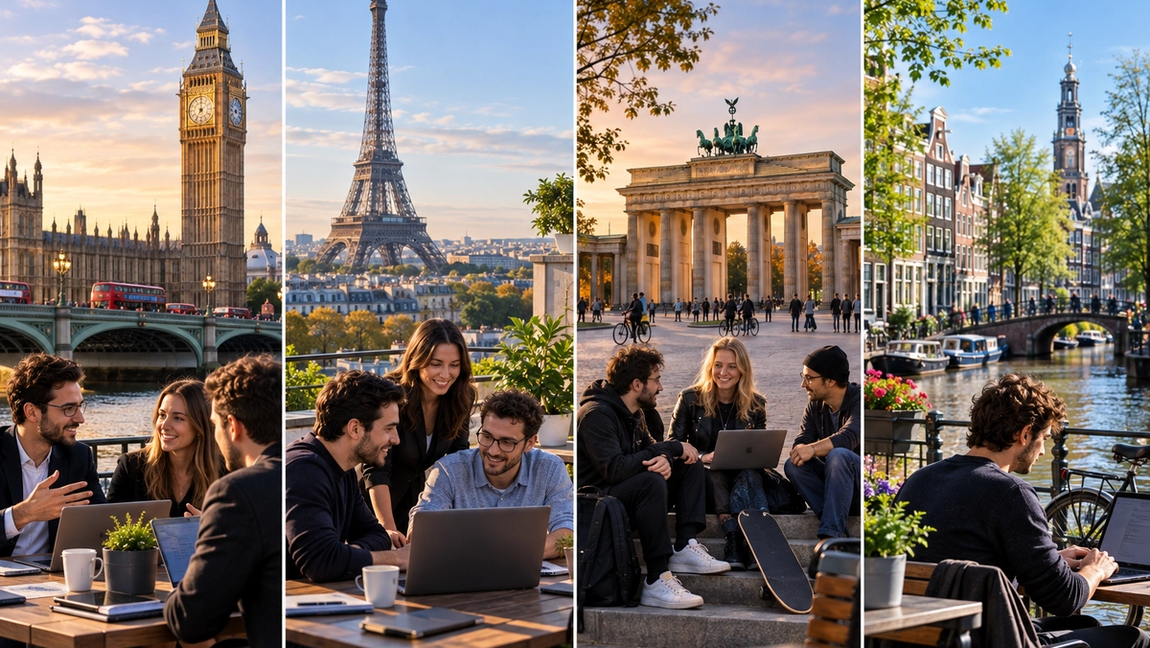
London, Paris, Berlin, and Amsterdam are regularly grouped together as Europe’s major technology hubs. On a ranking, that makes sense. In practice, building a startup in each city can feel surprisingly different.
By Ray Vasquez on September 17, 2026
Getty Images
London, Paris, Berlin, and Amsterdam are regularly grouped together as Europe’s major technology hubs. On a ranking, that makes sense. In practice, building a startup in each city can feel surprisingly different.
London has Europe’s deepest pool of venture capital and the strongest connection to global finance. Paris has become a major center for AI and benefits from unusually active government support. Berlin remains famous for its international startup culture and relatively experimental founders. Amsterdam is smaller, but combines an international workforce with strong infrastructure and easy access to the wider European market.
The numbers show the difference in scale. Data cited in Berlin’s 2025 ecosystem report estimated the enterprise value of London’s technology ecosystem at €643 billion, compared with €282 billion for Paris, €256 billion for Amsterdam, and €169 billion for Berlin. Since 2020, London also attracted substantially more venture investment than the other three.
But size alone does not tell you which city is “best.” Each one works particularly well for different kinds of founders.
London is Europe’s capital and finance machine
If your priority is access to investors, international customers, experienced executives, and a huge professional-services network, London is difficult to beat.
Startup Genome’s 2026 ranking places London among the world’s top three startup ecosystems, alongside Silicon Valley and New York. London also remains Europe’s largest ecosystem by a considerable margin.
Its strength is breadth.
London is strong in fintech, AI, enterprise software, climate technology, life sciences, cybersecurity, and numerous other sectors. The city combines startup investors with banks, hedge funds, private-equity firms, corporate headquarters, universities, and international technology companies.
That makes London particularly powerful for companies selling into finance or large enterprises.
It is also one of Europe’s major AI centers. Companies including Google DeepMind, ElevenLabs, Wayve, and Synthesia have helped create a dense AI talent network, while international AI businesses continue establishing substantial operations in the city. London attracted $17.8 billion in technology investment during 2025, according to Dealroom data reported in 2026.
The downside is obvious: London is expensive.
Salaries, offices, housing, and general operating costs can make it a difficult place for an early-stage startup trying to extend a small seed round.
But if you need capital and global connections, London remains Europe’s closest equivalent to a traditional Silicon Valley-style ecosystem.
Paris has become Europe’s AI powerhouse
Paris feels different.
For years, France had excellent engineers and researchers but was sometimes perceived as a difficult environment for building high-growth startups.
That image has changed dramatically.
Paris is now Europe’s second-ranked startup city in StartupBlink’s 2026 index and the highest-ranked startup ecosystem within the European Union.
Artificial intelligence has accelerated that transformation.
Mistral AI has become one of Europe’s most important AI companies, while Paris benefits from strong mathematics, engineering, and computer-science institutions. Startup Genome estimates the city’s AI-native ecosystem value at more than $20 billion, following rapid growth over the previous two years.
Paris also illustrates something distinctive about the French model: government involvement.
France has deliberately attempted to create conditions for technology companies through public investment, startup programs, research support, tax incentives, and policies designed to attract entrepreneurs and technical talent.
That gives Paris a more coordinated feel than some European ecosystems.
The city’s strengths increasingly include AI, deep tech, fintech, climate technology, and enterprise software.
For founders building technically ambitious companies—particularly businesses connected to AI or scientific research—Paris has become difficult to ignore.
Berlin is Europe’s startup culture laboratory
Berlin’s technology identity grew differently.
It did not become a startup hub because it was Europe’s financial capital or because the government decided to create a technology district. It attracted entrepreneurs partly because it was international, creative, relatively affordable, and willing to accommodate unconventional careers and companies.
That culture remains one of Berlin’s biggest advantages.
The city’s technology workforce is exceptionally international. Berlin’s ecosystem report says roughly half of its technology employees come from outside Germany, creating an environment where English is common inside startups and founders can recruit internationally.
Berlin has produced major companies across e-commerce, fintech, mobility, software, marketplaces, and consumer technology.
It also remains extremely active at the early stages. Since 2024, Berlin recorded nearly 1,000 funding rounds in Dealroom data cited by the Berlin government—roughly comparable with Paris and second only to London among major European hubs.
However, Germany’s technology ecosystem is becoming more distributed.
Munich has become increasingly important for deep tech, defense, industrial technology, and university spinouts. Germany’s strength is therefore no longer concentrated entirely in Berlin.
Berlin’s particular advantage remains its founder culture. If London feels connected to finance and Paris increasingly feels connected to engineering and national industrial strategy, Berlin still feels most obviously like a startup city.
Amsterdam is smaller but unusually international
Amsterdam does not have London’s scale, Paris’s AI momentum, or Berlin’s startup mythology.
But its smaller size can be deceptive.
StartupBlink ranks Amsterdam fifth among European startup cities in 2026, narrowly behind Stockholm and ahead of many much larger cities.
The Netherlands offers several advantages to technology companies: strong digital infrastructure, widespread English proficiency, international talent, geographic proximity to Europe’s largest markets, and a business environment accustomed to operating across borders.
Amsterdam has particular strengths in fintech, payments, software, marketplaces, climate technology, and digital commerce.
It has also produced or hosted companies with international influence far beyond what the city’s population would suggest.
For founders, Amsterdam’s location can be particularly useful. London, Paris, Brussels, and major German business centers are relatively close, making the Netherlands a natural base for companies thinking about the European market as a whole rather than one domestic market.
The trade-off is ecosystem depth.
Amsterdam attracted €11.3 billion in venture investment between 2020 and the period covered by Berlin’s 2025 ecosystem report, compared with €28.3 billion for Berlin, €43.4 billion for Paris, and €97.1 billion for London.
A founder looking for a very specialized investor or executive may therefore find fewer options locally than in London.
The best city depends on what you are building
There is no universal winner among the four.
London is the strongest choice when capital, global finance, international investors, and ecosystem scale matter most.
Paris has become particularly compelling for AI, deep tech, engineering-heavy companies, and founders who can benefit from France’s technology policy and research ecosystem.
Berlin offers an international founder community and a culture particularly suited to experimentation, software, consumer businesses, and early-stage company building.
Amsterdam offers a smaller but highly international environment that can work extremely well for founders who want easy access to the broader European market.
The rankings broadly reflect this hierarchy: London remains clearly first, Paris second, Berlin third, while Amsterdam sits among Europe’s next group of leading hubs. But rankings cannot capture everything that determines whether a company succeeds.
The more useful question is not, “Which European city has the best tech scene?”
It is, “Which ecosystem gives this particular company the unfair advantage it needs?”
For a fintech founder, the answer might be London. For a frontier AI company, Paris could make more sense. For an international software startup assembling an unconventional early team, Berlin might be ideal. For a company using one compact headquarters to sell across continental Europe, Amsterdam could be exactly right.
Europe does not have one Silicon Valley.
It has several very different technology capitals—and that may ultimately be one of its biggest strengths.